
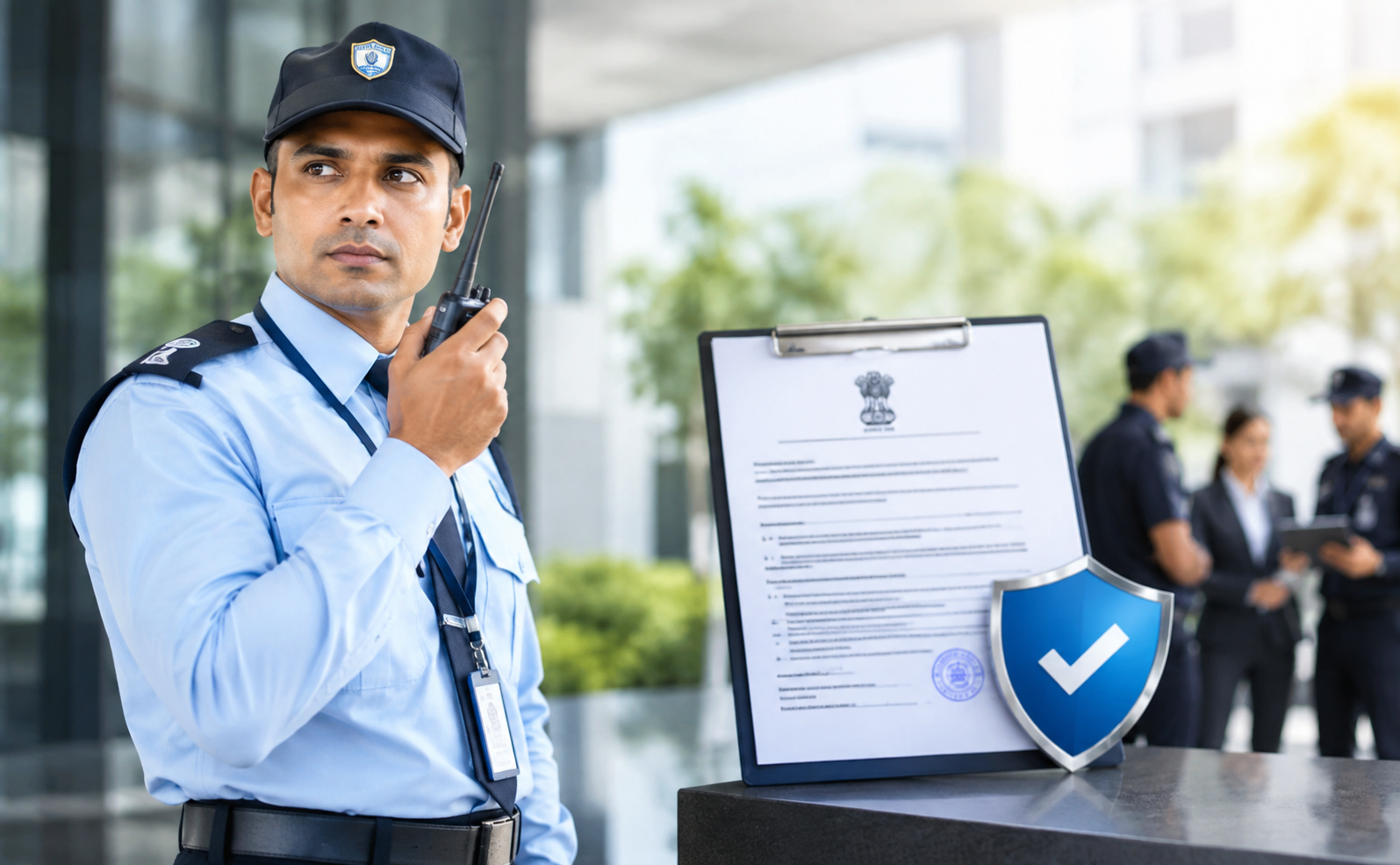
Engaging a security company is not merely a matter of employing a security guard at the entrance of your premises. It entails giving that individual the right to take care of your property, your employees, and sometimes even your family. There is an obligation that comes along with this right, which has been clearly established in Indian law. This is referred to as the PSARA license.
In case you are considering engaging a PSARA-licensed security firm to take care of your office premises, your residential community, your factory, or your function, this guide will help you understand what exactly the license is, its importance, and how to determine whether the firm in question actually has the license or not.
What Is PSARA Act?
The private security agency regulation act, officially called the Private Security Agencies (Regulation) Act, 2005, is the primary legislation which determines how private security agencies are supposed to function in India. This act was introduced in order to regulate an industry which did not have any standardized criteria to decide whether individuals can employ armed or unarmed security guards.
According to this act, no organization can legally offer security services without being registered with the State Controlling Authority and getting a license to do so. Moreover, this act includes provisions about training, background verification, uniforms, weapon handling, and behaviour of each employed security guard. One can see the original text of the Private Security Agencies (Regulation) Act, 2005 on the website of the Ministry of Home Affairs.
Thus, the question of what the PSARA act can be answered as follows: it is the law which regulates who can engage in the business of providing security services in India and how this should be done.
What Is a PSARA License Security Agency?
A PSARA license security agency is a company that has cleared this registration process with the state government and holds a valid, current license to operate. Getting there is not quick. These include submitting their business papers, passing police clearance of their directors and important staff, affiliating themselves with an authorized training institution, and showing that they are able to discharge the payment responsibilities towards their guards.
The license once granted will be for a fixed period and will have a fixed geographic location. For example, if an agency runs its operations in the Delhi-NCR area, then it must have valid licenses for all states where it employs its guards, as PSARA approval is not transferable from one state to another.
This distinction matters more than most people realise. Plenty of firms describe themselves as "security providers" without ever completing this process. A licensed agency, by contrast, has been checked, trained, and made accountable to a government authority before it ever sends a guard to your premises.
Why a PSARA License Matters When Hiring Guards
Legal Compliance
Operating with an authorized firm will ensure that you comply with the laws. The firm has registered with the state Controlling Authority and can therefore be traced, audited and held accountable should anything go wrong. Businesses that may unknowingly employ guards who are not licensed can end up in trouble themselves, risking being closed down without prior notice.
Background Verification
PSARA rules require every guard to go through a police antecedent check before deployment. This is not a formality, it is meant to rule out anyone with a criminal record before they are given access to your property. Skip the license, and you are very likely skipping this check too.
Trained Personnel
Licensed firms must train their guards before deployment. The training includes physical conditioning, fire safety measures, first aid and emergency procedures. An agent who has gone through training will behave differently in case of an emergency than an agent who has just been provided with a uniform.
Reduced Liability
Unlicensed operators frequently cut corners on minimum wages, provident fund contributions, and ESI coverage for their staff. When that happens, the liability does not just stay with the agency, it can land on the business that hired them, especially in the event of a workplace injury or a labour dispute. A properly licensed agency carries these statutory obligations itself.
Higher Accountability
Licensed agencies are expected to maintain duty rosters, attendance registers, and supervision records. This paperwork sounds unglamorous, but it is what separates a professionally run security operation from one that is managed on trust alone. It gives you something to point to if a shift is missed or a guard's conduct needs to be reviewed.
PSARA Licensed Security Company in Noida: What to Look For
Noida sits under the Uttar Pradesh Controlling Authority for PSARA licensing, which means a PSARA licensed security company Noida businesses hire from needs a license issued specifically for Uttar Pradesh, not one borrowed from a Delhi or Haryana registration. This detail gets missed often, especially by agencies that operate across the NCR region and assume one license covers the whole belt.
Before signing with any provider in Noida, ask to see the UP-specific license document, not just a company brochure or a generic compliance certificate. A genuine agency will have no hesitation showing it, since the license is meant to be displayed at their place of business in the first place.
At Conquer Services, every guard deployed across Delhi NCR, including Noida, is placed under a valid, state-specific PSARA license, with documentation available for your records before deployment begins.
How to Verify a Security Agency's License in India
Knowing how to verify security agency license India business can rely on is simpler than it sounds, if you know where to look.
Start by asking the agency directly for a physical or digital copy of their PSARA license. A legitimate license will show the license number, the issuing state, the date of issue, and the validity period. From there, cross-check the license number against your state police department's private security section — most states, including Uttar Pradesh, maintain an online record of licensed agencies through their official police portal. You can start with the Uttar Pradesh Police's private security agency information page for state-specific guidance, or check the Ministry of Home Affairs' national services portal for broader PSARA-related information.
It also helps to ask for the training certificates of the guards being deployed and confirm that the agency's Principal Officer credentials match what is on file. None of this takes more than a short conversation and a few documents, but it is the difference between hiring blind and hiring with confidence.
Licensed vs Unlicensed Security Guards: What Actually Changes
The gap between licensed vs unlicensed security guards is not just paperwork. It shows up in how the guard behaves on the ground.
A licensed guard has passed a police background check, completed formal training, and works under an agency that is answerable to a government authority. An unlicensed guard may have none of this behind them — no verified background, no structured training, and no real accountability if something goes wrong during their shift.
The cost difference between the two can be tempting, especially for smaller businesses trying to cut expenses. But the risk sits entirely with the business that hires the cheaper, unverified option. If an incident occurs, an unlicensed agency offers little recourse, while a licensed one is bound by the terms of a regulated contract and can be held to it.
Key Checks Before You Sign a Security Contract
A few checks, done before you sign anything, can save considerable trouble later.
Confirm the agency's PSARA license is valid for the exact state your property sits in, since licenses do not carry over between states. Ask to physically inspect the license document rather than accepting a verbal assurance, and request proof of guard training along with any preference given to ex-servicemen, which many agencies highlight as part of their staffing. Finally, make sure guard rotation, supervision responsibilities, and compliance obligations are written into a formal agreement, not left as an informal understanding. A written contract protects both sides if expectations are not met.
Choosing a Licensed partner You Can Rely On
A PSARA license is not a box to tick during onboarding, it is the clearest signal you have that a security agency takes its legal and ethical obligations seriously. It tells you the guards standing at your gate have been checked, trained, and placed by a company that has something to lose if it cuts corners.
Conquer Services operates as a fully PSARA-compliant security guard services provider across Delhi NCR, with documentation available for review before any deployment. If you are comparing agencies for your property, start with the license, and let everything else follow from there.
Frequently Asked Questions
Is it illegal to hire a security agency without a PSARA license?
Yes. Only those private security agencies that are licensed under the Private Security Agencies (Regulation) Act of 2005 are authorized to deploy security personnel legally. Any hiring of such security personnel without a license could put you at risk if ever investigated by local authorities.
Does a PSARA license apply across all states in India?
Not at all. Every state has its own licensing program, implying that an agency will require a license in each state in which security officers will be deployed.
How long does a PSARA license remain valid?
The typical validity period of a PSARA license is five years, and then the agency is expected to apply for the renewal of the license before the Controlling Authority.
What documents should I ask an agency to show before hiring them?
Request the PSARA license, showing the license number and expiry dates, in addition to documentation proving that the guards have undergone training and background verification. This should not pose a problem for a licensed security firm.
Can an unlicensed agency still provide trained and background-checked guards?
In theory, yes, but there is no body that makes sure of this for unlicensed agencies. Without being licensed, there is no requirement for background verification and training, hence no way of knowing whether the guards provided are of good calibre or not.

Add a Comment
Your email address will remain private. Comments appear after approval.
Comments 0