
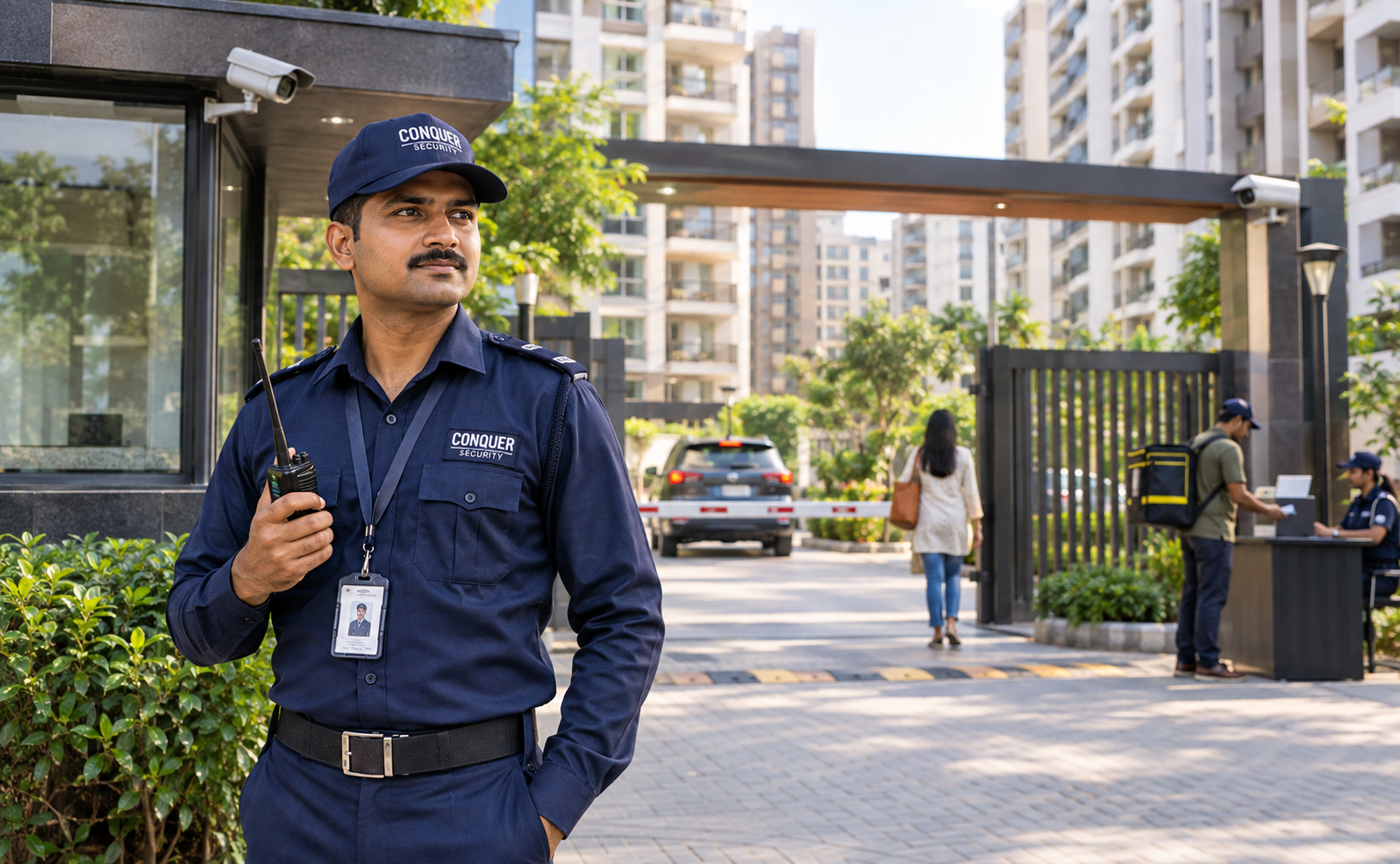
The security level of a housing society can be ascertained from how the guards behave in their routine tasks daily. Most people think that security guards for residential societies will ensure the safety of the people living there, but employing a guard who just stands by the gate without any verification and protocol is nothing but a uniform. The real security lies in having a list of tasks that guards, RWA, and the security agency follow.
This guide breaks down exactly what that checklist should include, from how guards are verified before deployment to how they respond when something actually goes wrong at 2 a.m. Whether you're an RWA committee member reviewing your current security contract or a resident trying to understand what "good security" should actually look like on paper, this checklist gives you a practical benchmark to work from.
Residential Society Security Checklist at a Glance
The table below summarizes what each part of the checklist covers and why it matters, the sections further down explain each area in detail.
| Security Area | What It Covers | Why It Matters |
|---|---|---|
| Guard Verification & Credentials | PSARA licensing, police verification, language and communication skills | Confirms guards are legally deployed, background-checked, and able to respond in an emergency |
| Gate & Access Control | Visitor pre-registration, anti-tailgating measures, delivery logging, uniform and ID | Stops unauthorized entry at the single most exploited point in a society |
| Patrolling & Surveillance | Randomized routes, night patrol protocols, live CCTV monitoring, patrol equipment | Covers the property once someone is inside, and deters incidents rather than just recording them |
| Emergency Preparedness | Fire safety inspections, evacuation drills, emergency contact lists | Ensures a coordinated, practised response when something actually goes wrong |
Why Residential Societies Need a Structured Security Checklist
Apartment complexes and gated communities are different from standalone homes or commercial buildings. Whether you call it a residential society or use the more common search term, security guards for housing societies, the underlying need is the same: hundreds of families, dozens of daily visitors, delivery agents, domestic help, and service vendors moving in and out, all in the same 24-hour window. Without a defined protocol, even well-meaning guards end up making inconsistent judgment calls: one lets a cab through without checking the booking, another forgets to log a delivery boy's entry, and a third skips the midnight patrol because nothing "usually happens."
A checklist removes that inconsistency. It gives gated community security guards a repeatable standard to follow on every shift, and it gives the RWA a clear way to audit whether the security agency is actually delivering what was promised in the contract. It also protects the society legally if an incident does occur, a documented protocol shows that reasonable, consistent precautions were in place, rather than security being handled on an ad-hoc basis.
Guard Verification & Credentials
Before a guard is deployed at your gate, the agency supplying them should be able to answer four questions clearly: who is this person, is he trained, is he licensed, and can he communicate with residents in an emergency.
Valid Licensing and Agency Credentials
Every private security agency operating in India is required to hold a license under the Private Security Agencies (Regulation) Act, 2005 (PSARA), administered by the Ministry of Home Affairs. Before signing a contract, an RWA should ask for the agency's PSARA license number and confirm it is active for the state the society is located in. An agency that cannot produce this on request should be treated as a red flag, regardless of how competitive its pricing is.
Background Checks and Police Verification
PSARA also mandates police verification for every guard before deployment, not just at the time an agency is set up. This isn't paperwork for its own sake it's the single most important filter for keeping known offenders out of a residential complex. Ask the agency for verification proof for each guard posted at your society, and request updated records whenever a guard is rotated in.
Communication Skills and Local Language Proficiency
A guard that is unable to communicate with the residents in the event of an emergency becomes part of the problem rather than being a solution. Guards should be fluent in the local language, confident with the intercom system, and adept at using the smartphone for visiting confirmation applications. This is important because in an emergency situation, even thirty seconds become critical.
Gate and Access Control Protocols
The main gate is where most security failures actually begin. Almost every unauthorized entry into a residential society traces back to a lapse at this single checkpoint.
Visitor Pre-Registration
Guests, cabs, and delivery riders should only be allowed in after the resident confirms entry through an intercom call, a visitor management app, or a manual gate log signed off by the flat owner. Guards should never wave someone through simply because they "look fine" or claim to know a resident.
Preventing Tailgating
Tailgating, where an unauthorized vehicle slips in directly behind an approved one, is one of the most common gaps in site security. Boom barriers combined with physical verification at every entry (not just the first vehicle in a queue) close this loophole. Guards should be trained to stop and check each vehicle individually, even during peak entry hours when residents are in a hurry.
Delivery and Service Staff Management
With the rise of quick-commerce and food delivery, societies now see dozens of delivery personnel entering daily. Every delivery and service staff entry and exit should be logged digitally, with a name, purpose of visit, and timestamp. This creates an audit trail that becomes critical if anything goes missing or if there's a dispute later.
Uniform and Visible Identification
Every guard on duty should wear the agency's uniform along with a visible ID badge at all times. This sounds basic, but it's one of the easiest things for RWAs to overlook during periodic checks and one of the fastest ways residents can spot someone who doesn't belong.
Patrolling and Surveillance Standards
Gate security handles who comes in Patrolling handles everything that happens once they're inside or after they've left.
Randomized Patrol Routes
Guards should walk scheduled patrol routes across boundary walls, parking levels, service corridors, and common areas, but the timing shouldn't be predictable. A patrol that happens at the same minute every hour is easy for anyone watching the property to plan around. Randomized routines close that predictability gap.
Night Patrol Protocols
Late-night hours, particularly after midnight, call for a two-guard patrol system rather than a single guard walking alone. This isn't just about coverage; it's about guard safety too, since a lone guard confronting a trespasser at 2 a.m. is in a genuinely vulnerable position.
Active CCTV Monitoring
Putting in cameras is one part of the process. Videos have to be monitored, and not just recorded, to be seen at a later stage after the event has taken place. Live monitoring will enable the guard or supervisor to take action while the event is still taking place.
Essential Patrol Equipment
The guards on patrol should carry the following basic equipment, a flashlight for dim light conditions, a whistle to signal an emergency, and, if necessary, a handheld metal detector on days when there are special events or a lot of people visiting.
Emergency Preparedness
A society's security checklist isn't complete until it accounts for the moments when things go wrong fire, medical emergencies, or any situation that requires an immediate, coordinated response.
Safety Gear Inspections
Fire extinguishers, alarm systems, and emergency exits should be physically inspected on a monthly basis, not just installed once and forgotten. The National Disaster Management Authority (NDMA) publishes fire safety guidelines for residential buildings that RWAs can use as a reference point when setting their own inspection schedule.
Evacuation Drills
Regular safety and evacuation drills, run jointly with the security team, ensure that both residents and guards know exactly what to do when an alarm actually goes off. A fire alarm that residents have never heard tested before an emergency tends to cause confusion instead of action.
Emergency Contact Lists
Every guard post should have an updated, physically visible list of local emergency numbers police, fire, and medical services. India's unified emergency helpline, 112, run under the Ministry of Home Affairs' Emergency Response Support System, should be the first number on that list, alongside the direct contacts for the nearest police station and hospital.
Choosing the Right Security Partner for Your Society
A checklist is only as good as the agency executing it. When evaluating residential security guard services, RWAs should look past the quoted price per guard and ask harder questions: Is the agency PSARA-licensed for this state? What does their guard training actually cover? How do they handle guard rotation and backup coverage during leave or illness? Do they conduct their own periodic audits of gate logs and patrol records?
A security agency that welcomes these questions and can show documentation to back up its answers is generally the one worth trusting with a residential community.
It also helps to ask how the agency handles supervision. A guard posted at the gate is only one part of the system; a supervisor who periodically visits the site, checks logs against actual entries, and addresses gaps in real time is what turns a checklist from a document into an enforced standard. Societies that build this supervisory review into their contract tend to see far fewer lapses over time than those that rely purely on the guards' own discipline.
Final Word
Security in a residential society isn't a one-time setup, it's a routine that has to be followed correctly every shift, every day. A well-verified guard, a disciplined gate protocol, consistent patrolling, and a tested emergency plan together form a system that actually protects residents, not just the appearance of security. Use this checklist as a working document with your RWA and your security provider, and revisit it periodically as the society's needs change.
Frequently Asked Questions
How many security guards does a residential society typically need?
This depends on the number of entry/exit points, society size, and whether round-the-clock coverage is required. A mid-sized gated community usually needs a minimum of one guard per gate per shift, plus additional guards for patrolling and parking areas.
What is the difference between a PSARA-licensed guard and an unlicensed one?
A PSARA-licensed guard has gone through mandated training and police verification, and works for an agency accountable to a state Controlling Authority. An unlicensed guard offers none of these safeguards, which puts both residents and the society's legal standing at risk.
Should a residential society deploy armed or unarmed guards?
Most residential societies operate safely with unarmed, PSARA-trained guards supported by strong access control and CCTV monitoring. Armed deployment is generally reserved for high-risk sites and is not typical for standard housing societies.
How often should CCTV footage be reviewed in a housing society?
Live feeds should be actively monitored during all shifts, not just recorded. Recorded footage should additionally be spot-checked weekly and retained for at least 30 days in case of any dispute or incident review.
What documents should an RWA verify before hiring a security agency?
At minimum, the agency's PSARA license, individual guard police verification records, proof of guard training, and details of their supervisory and backup staffing structure.
Add a Comment
Your email address will remain private. Comments appear after approval.
Comments 0